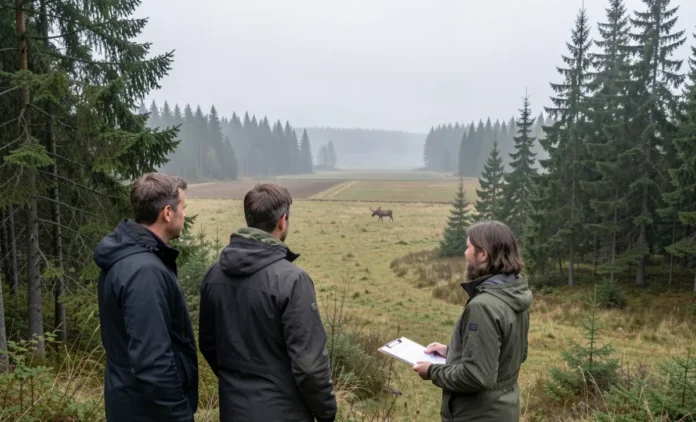
Viltnemnda is Norway’s municipal wildlife committee system. Each municipality appoints its own board, made up of local hunters, farmers, and community members, to handle wildlife decisions at the ground level. They work within the national Wildlife Act but adapt their approach to local conditions, covering hunting quotas, human-wildlife conflicts, and population monitoring.
These committees are a practical link between national policy and what actually happens in the field. They don’t just manage paperwork. They talk to landowners, respond to damage reports, and make calls that affect real people and real animals. If you live near the Norwegian wilderness, Viltnemnda shapes more of your daily environment than you might realize.
What Viltnemnda Actually Is
Have you ever wondered who decides how many moose can be hunted in your local area? Or who shows up when a bear starts wandering too close to a farm? In Norway, that’s Viltnemnda, a municipal wildlife committee found in every municipality across the country.
The name translates directly to “wildlife committee.” Each board is appointed by the local municipal council and typically includes five to nine members. These are people with hands-on knowledge of the area, farmers who have watched wildlife patterns for decades, hunters who understand animal behavior, and community members with a stake in the land.
They’re not officials sent in from outside. They live where you live. That local connection is exactly the point.
How Viltnemnda Works on the Ground
Viltnemnda operates under Norway’s Wildlife Act, known as Viltloven. The national law sets the broad framework, but each committee applies it to fit its specific area. A rule that works in the coastal lowlands of Vestland may not make sense in the dense forests of Hedmark.
In practice, the committee reviews local wildlife data throughout the year. They look at population counts, hunter observations, camera trap reports, and damage assessments from landowners. Based on that, they make decisions about quotas, permits, and conflict cases.
Most municipalities now run their processes digitally, so you can find meeting minutes, quota decisions, and contact information on your local council’s website.
Key Responsibilities You Should Know About
Viltnemnda handles more than just hunting permits. Here is what falls under their authority in a typical Norwegian municipality:
- Setting annual hunting quotas for big game species, including moose, red deer, roe deer, and reindeer
- Approving hunting plans submitted by landowner groups
- Handling reports of wildlife causing damage to crops, livestock, or infrastructure
- Issuing emergency permits to remove problem animals
- Advising on habitat protection measures in cooperation with landowners and forest managers
- Collecting local observations to support population monitoring
It’s a wide scope for a group of people who mostly volunteer their time alongside regular jobs and farm work.
A Real Example of Human-Wildlife Conflict
To understand what Viltnemnda actually does day to day, consider a situation that played out in a farming valley in Trøndelag a few years ago. A family of bears had started moving through the area regularly, coming close to farm buildings and pastures. Sheep farmers were worried. Some families with young children were uncomfortable letting the kids play outside.
At the same time, several residents valued having bears in the area and didn’t want them removed. The committee had to find something that worked for everyone, including the bears.
They worked with the county governor to get funding for electric fencing and livestock guard dogs. They also set clear guidelines on when the situation would require further action if the bears became too comfortable around buildings. The bears stayed. The farmers felt protected. And the community kept something most municipalities no longer have.
That’s the kind of decision that needs local context to get right.
Norway Wildlife Management and the Climate Question
Wildlife management in Norway is getting more complicated, and climate change is a big reason why. Warmer winters mean higher calf survival rates for moose and deer, which sounds positive until you realize the land has limits. More animals competing for the same food sources can cause overgrazing, weaker herds, and higher crop damage for farmers.
On the other side, some species are struggling. Reindeer in highland areas face harder grazing conditions as ice crust forms more often on top of the snow. Spring arrives earlier in some regions, shifting the timing of plant growth that animals depend on.
Viltnemnda committees are already being asked to adjust quotas more frequently than they did ten years ago. Some municipalities are also seeing species in areas where they weren’t present in living memory. These shifts will likely keep coming, which means local knowledge and quick local decisions matter more, not less.
How Farmers and Hikers Can Get Directly Involved
You don’t have to be a hunter to have a reason to engage with your local Viltnemnda. If you’re a landowner, a farmer, or someone who spends time outdoors, your observations are genuinely useful to them.
Here is how you can connect:
- Visit your municipality’s official website and search for “viltnemnda” or “viltforvaltning” to find contact details and meeting schedules
- Attend a public meeting, they’re open and free, and you’ll hear what’s actually being discussed in your area
- Submit observations directly, whether it’s an unusual sighting, signs of disease in animals, or recurring damage to your property
- Contact the board secretary if you have a specific issue to raise before a meeting
Landowners especially benefit from building a relationship with the local committee early. Wildlife doesn’t stop at your fence line, and committees rely heavily on what people on the land see and report.
Viltnemnda vs. National Wildlife Agencies
It helps to understand where Viltnemnda fits in the larger structure of wildlife conservation in Norway.
National agencies, particularly Miljødirektoratet (the Norwegian Environment Agency), set overall conservation targets, manage protected species, and handle issues that cross municipal or county lines. They make the big-picture decisions.
Viltnemnda operates at a much more specific level. They apply national rules to local conditions, handle permit applications, respond to conflicts, and feed local data back into the broader system. Think of it as two layers working together, one setting direction, the other making it work in practice.
Some critics argue that local boards can be too influenced by hunting interests, and that more national oversight would improve consistency across municipalities. That’s a fair concern. A committee dominated by one perspective can miss things. The best boards actively seek input from farmers, conservation voices, and general community members to keep the picture balanced. The debate about where exactly to draw the line between local authority and national oversight is ongoing, and it’s worth following if you care about sustainable hunting practices and wildlife conservation in Norway.
FAQs
What does Viltnemnda actually do in a typical Norwegian town?
In a typical municipality, the committee sets hunting quotas for the season, reviews any applications for special permits, and responds to reports of wildlife causing problems for residents or farmers. They also collect observations from locals to help track population changes over time.
How can locals report wildlife issues to Viltnemnda?
The easiest first step is to find your municipality’s website and search for the wildlife committee contact. You can also contact the municipal environmental office directly. For anything involving a dangerous animal or an immediate threat, contact the police first.
What’s the difference between Viltnemnda and national wildlife agencies?
National agencies like Miljødirektoratet set overall rules and manage protected species at a country level. Viltnemnda applies those rules locally and handles the practical decisions that affect your specific area. The national level sets the framework; the local committee works within it.
How does Viltnemnda handle injured animals or roadkill?
Injured animals, especially after road collisions, are typically handled through a coordinated system involving the committee, local hunters trained as wildlife emergency responders (called “ettersøkslag”), and the police. If you encounter an injured animal on or near a road, call the police, who will contact the right people. Roadkill is also tracked and reported back to the committee as part of local population monitoring.