Most people think buying a shipping container is a simple task. Just go to a seller and buy the container. But what happens when one seller has a used container for a very low price and the other seller is trying to sell the container for way more?
Buying a used cargo container is not random because there is a pattern for pricing and it takes into account the condition of the container, size of the container, when you view container pricing by size, the current state of the market, and the location of the seller.
I remember one time when I had a client and I was helping them source a few containers to build a small storage yard. I made the mistake of just looking for the cheapest option. I was looking at pictures and the container looked good, but when the container was delivered it had a bunch of issues, such as the floor was damaged and the doors wouldn’t align. I learned that the price you have to pay is not as important as what you get for the price you pay.
If you hope to check price trends for shipping containers, source container pricing by size, and check container pricing with no fear of regret, this guide is for you then. This guide analyzes every single factor that is important to pricing so that you are able to buy containers in the way that is the smartest and most effective to avoid surprises.
Changes in the Wholesale Prices of Used Shipping Containers
Containers continue to be one of the most resilient sources of shipping material in the world. After being used to ship goods, shipping containers can be used in other ventures, such as cargo transport. The versatility of shipping containers means that they are in high demand in the transport industry.
However, the level of demand can change drastically, which can affect the prices of used shipping containers in the wholesale market. Shifts in demand levels due to trends in the import and export industry mean that the prices of used shipping containers must be monitored closely in order to claim optimal profits.
Shipping prices can also differ due to geographic distribution factors. The prices of used shipping containers may be higher in heavily populated areas. Extra shipping costs may come into play if the used shipping containers must be dragged to different locations in order to reach the desired shipping destination.
Factors Causing Changes in the Pricing of Used Shipping Containers
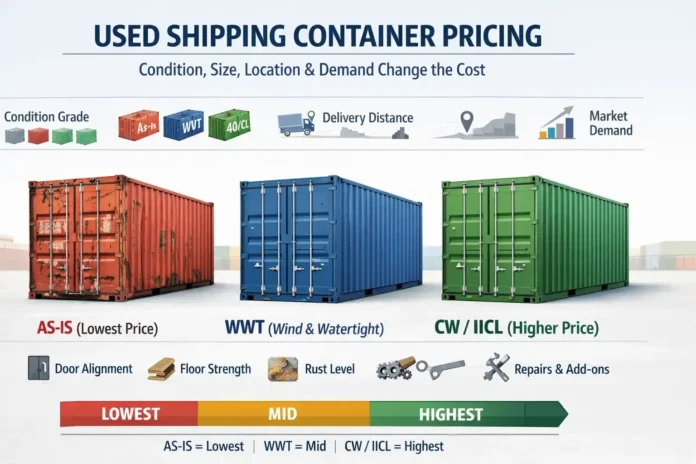
Different prices can also be attributed to the wholesaler’s different measurements of the used shipping containers. Some wholesalers may describe their containers as being “as is” or “cargo worthy.” The description of used shipping containers can drastically influence the prices.
“As Is” Containers
The shipping containers in the “as is” category are the most reasonable prices, but they can have harmful things such as rust, bent metal, worn out flooring, or problematic door issues.
They are probably acceptable to use for storage containers if there are no aesthetics to consider. Nonetheless, they can be dangerous to use if reliability is needed.
Wind and Watertight (WWT)
This is a popular middle-ground category. A wind and watertight container usually has working doors and no roof and wall holes.
It may still show visible wear, but it should protect items from wind and water.
Cargo Worthy (CW) or IICL
Containers in the Cargo Worthy category have been assessed and are a safe bet to meet the shipping standards for transport. These often cost more because they are structurally more sound and have fewer problems.
IICL-grade containers are a step-up from that and are usually of a higher caliber, often with less damage and more dust-free interiors.
When looking at container prices based on their condition, always verify what the condition label from the seller actually means. Some use “WWT” a bit more loosely, which makes it more important to have at the very least a visual inspection and photos.
Container Pricing Based on Size
Another major cost factor is the size. Larger shipping containers use more steel and are therefore more expensive to transport, and have higher costs to deliver. A larger container does not always give a better value depending on what you need.
10-Foot Containers
These can be more difficult to locate because they have been custom cut-down units. Pricing may be higher than expected because of this.
They are most suitable for limited storage areas or where jobsite space is at a premium.
20-Foot Containers
The 20-foot containers are straightforward to purchase and are highly versatile. Therefore, they are popular with storage facilities, construction, farms, and others, as they are cost-effective in terms of delivery and storage.
40-Foot Containers
40-foot containers provide double the storage space of the 20-foot container. However, that does not necessarily mean that they are double the cost. In some cases, they are even a more economically viable solution.
On the downside, they are more difficult to transport due to the added weight and require more space for unloading.
High Cube Containers
High Cube containers are an additional foot in height, and therefore provide some extra space. This is beneficial for tall equipment and modifications.
Because they are in demand, they do tend to cost more than standard height models. Additionally, it is important to consider transport costs when comparing container prices. In some cases, transport charges can exceed the cost of the containers themselves.
One Trip Container Costs vs Used Units
One trip containers are units that have only been used for a single voyage overseas. Because of this, they are considered to be cheaper, “almost new” containers. They typically have less wear, are cleaner, have less rust, and better doors.
There is an increase in pricing for containers on a one-trip basis primarily for the following benefits:
They present a more appealing aesthetic to patrons when used for storage, or in a business.
They tend to require repairs less frequently than other options.
They can be modified with less effort into an office, cabin, or workshop.
If a container is going to be on display to patrons, or utilized for a long duration, investing in the less inexpensive one-trip container would be a sound strategy.
The Impact of Location on Container Pricing
The location of purchase matters almost as much as the item itself. Containers near port cities tend to be used for affordable storage. Containers far from a port city tend to be available at a higher price due to the shipping costs that are associated with repositioning.
The following typically modify location:
Distance of delivery
Untended routes and associated fuel costs
The price of container delivery vs requests in the storage
The shipping demand to/from the location
The best approach at sampling the price of containers in a given radius is to request quotes in an area from at least two providers. It is recommended to compare the price of delivery and to take into account the price of the container.
Accounts Payable Pricing for Containers
In most cases, container buyers take into account the price shown to the container. It is usual for buyers to unfamiliarize themselves with the other costs associated with buying a container.
Delivering the cargo containers is one major expense. Some sellers might quote low initial prices but then charge exorbitantly for transport. If your site requires a crane or a forklift, unloading equipment can also increase the overall cost.
Repairs also count as “hidden” expenses. It’s always a good thing to contemplate a modular container on the low end.
Seal replacements for doors, rust treatment and painting, lockboxes for added security, and floor patching are just a few examples of things you might need to fix.
Make sure your container price calculator has a budget allocated for delivery, repairs, and unloading integrated into the overall price.
How to Buy Smart and Avoid Overpaying
When trying to compare used cargo containers pricing, the most sensible not overtly eager estimator should be employed.
From the start, it is advised to take and review the detailed photographs of the container and doors. If you notice not extremely problematic structural issues, the flooring, corners and posts, and the roof are the most telling.
If you can, it’s recommended to inspect the container in person or to request a walk-around video.
If the container will be used for shipping or international transport, be sure to confirm the container’s CSC plate and check the manufacturing date. It is less critical to have this information if the container will be used only for storage, but it can help to verify the overall quality of the container.
Lastly, in most cases, the prices, even in the same city, tend to differ widely where the same quality containers are present, so always have a variety of sellers to avoid putting your eggs into one basket.
Conclusion: Factors That Impact Pricing on Used Containers
The used container market is impacted by several clearly defined parameters: their condition, size, geographic location, how far they need to be transported, and the associated delivery costs.
There is a clear reasoning for each listing, but the best buyers analyze the pricing listing in the context of historical trends for shipping container pricing, container pricing correlation to size, and container pricing distributed by segment.
If the purpose of the container is for storage, wind and watertight containers with good floors and doors is a good idea.
For branding and container modifications, one-trip containers would be a better choice, for a better, longer lasting canvas.
And delivery costs and repair costs always need to be considered in the decision making process.
The better you understand the factors that impact pricing on used containers, the better your purchase will be, not just cheaper, but better.
FAQs
What is the reason for used shipping containers pricing in a way that is sometimes higher than expected?
When the demand is high, the supply is low and the distance of delivery is expensive, the prices go up. Even for a used container, pricing can go up if the condition grading and size of the container is larger.
Is a wind and watertight container good enough for storage?
Yes, wind and watertight containers are great for storage. Just ensure that the floor is in good condition and that the doors seal properly, and you should be good to go.
Is the additional expense for one-trip containers justified?
One-trip containers are justified when their durability, neat interiors, and overall appearance are prioritized. More often than not, they make long-term savings by eliminating the need for rust treatment and repairs.
Which container size do most customers prefer?
The most preferred size among customers is the 20-foot container. It is the ideal size that provides the best mix between cost, capacity, and delivery efficiency.
What is the best way to estimate cost in advance of a purchase?
The best way to estimate the cost is by using a container price calculator that factors in the repair costs, unloading, delivery, and the price of the container itself. Always request for a final delivered price to avoid any unexpected costs.