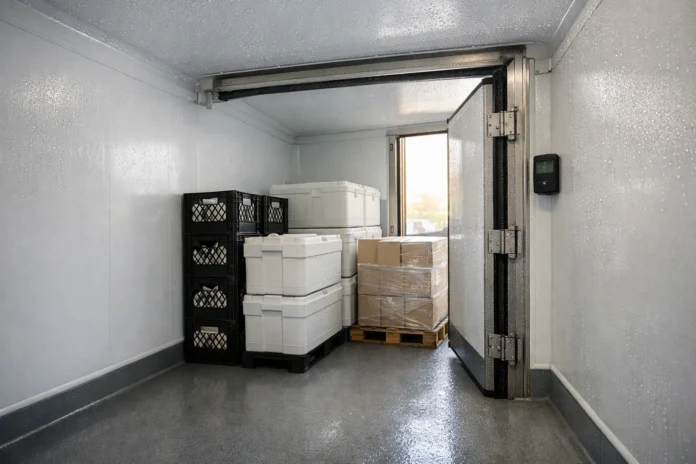
A milk path is a discipline of day by day. You may have the finest refrigeration unit in the market, and again lose it at a low temperature when your box cannot contain the cold. I have experienced the same trend over the years when reading refrigeration settings in the fleet maintenance notes and delivery performance reports: It is always the same team trying to pursue refrigeration settings, then traffic, and then door openings. It is usually the refrigerated box truck body itself, in particular the insulation thickness and the effectiveness with which the insulation is shielded by the panel system and joints and door sealing, that is the silent driver of consistency.
In case you are planning a new or an upgrade, the wisest place to begin would be this simple rule: consider insulation thickness as the part of a box design rather than an independent value. That is precisely where the solutions of visit composite-box, refrigerated box truck body usually perform well, as the current composite construction is designed to decrease the number of points of thermal leaks and enhance the durability of the composite material under the conditions of the real route.
Why Dairy Loads Require Improved Choices of Insulation
Dairy products such as milk, yogurt, cream, and chilled items are sensitive to temperature changes and frequent intrusion of warm air. Every door opening, on a multi-stop route, in a cold interior, puts in place humid air. Once such warm moisture comes in contact with cold surfaces, condensation occurs. Condensation does not merely denote water on the walls, but a process of moisture, odor danger, slippery floors and increased workload on the refrigerator.
Practically insulation thickness influences the speed to which the box recovers following every stop. A box with good insulation prevents rapid rise in temperature and therefore the unit is not forced to strain during deliveries. That assists in preserving product integrity, fuel consumption and equipment life.
Learning the Insulation Thickness: What It Is In Reality That It Controls
Thickness of insulation is approximated to resistance to heat. Increased insulation is typically better at thermal performance, but it has to be supported by the remainder of the build. I have experienced poor insulation due to bad door compression, open edges and thermal bridges formed by uncovered metal structure.
The question concerning the thickness and real-world performance is whether they are the same or not.
When Thickness Looks Good on Paper but Fails on the Route
A box may be amazingly thick in insulation on paper and still fail miserably in the day-to-day use when:
The joints between the panels are infiltrating.
The transitions between the floor and the wall are not closed.
The cold leaks occur through door frames and hardware.
Thermal bridging occurs when the structure of the roof takes place.
The conclusion is simple the thickness is important, however so is construction integrity.
Composite Panels and Lessened Thermal Intersection
Composite insulated body is also popular with dairy fleets since it can lessen exposure of metals to interiors and hence interior surfaces remain stable. With a regular insulation and skins bonded correctly, there will be fewer areas of weakness through which heat will penetrate. It implies a reduced number of hot corners, condensation, and a uniformity in air flow.
Which Insulation Thickness Is Rational at Dairy Run
It has no size that fits all the dairy operations due to the variations in dairy operations. Highway routes with few openings at long distances are not always served as effectively by long-haul insulations compared to city routes, where there are always stops. The correct decision is based on the frequency of stopping, ambient temperatures, delivery time window,s and the frequency of the drivers getting in the box.
Short-Stop Urban Routes
Urban dairy paths, in my case, expose all the weaknesses of a body. The doors are opened too often, humidity rises too often, and the unit is requested to recuperate fast. In this case, the thickness of the insulation in combination with good sealing and a well-developed door frame can be felt. Not cold, but cold stable.
Mixed Routes and Regional Runs: This Service Is Offered by Three Airlines: Southwest, Delta, and Spirit (Spencer, 2015)
Mixed Routes and Regional Routes: Three companies provide such service: Southwest, Delta, and Spirit (Spencer, 2015).
In terms of mixed driving patterns, the decision on insulation must be correlated with operational costs control. When your unit is cycling too frequently, there will be a rise in burn of fuel and wear. Good insulation performance assures less recovery load and is capable of stabilizing interior temperature bands.
The Unobtrusive Doors, Floors and Joints
When dairy operators report a temperature shift, I usually request them to inspect doors and floors and then touch the refrigeration controller. Why? The box is the envelope because of the box. In case of leaking of the envelope, the unit is battling a lost cause.
Door Compression and Gasket Health: The Door Compression and Gasket Health System Includes Service Components Designed to Guarantee That the Doors of the Vehicle Do Not Become Trapped and Obstruct Clear Visibility Through the Rear Windows (Sherman, 2013)
Door Compression and Gasket Health: The door compression and gasket health system comprises service parts that ensure the doors of the vehicle are not trapped and do not obstruct clear visibility through the rear windows (Sherman, 2013).
Gaskets are consumables, however, the door design defines the performance of gaskets. In case the compression is not uniform, you have micro-leaks. Micro-leaks invite humidity. Condensation is provided by humidity. Icing is formed along edges through condensation. That’s the loop.
Floors and Wash-Down Reality
The dairy fleets are washed frequently compared with other segments. The floor should not allow the intrusion of moisture and the floor to wall edge should be sealed appropriately. The lack of a good seal can enable water to seep in places where it is not supposed to be, harming performance.
Data Loggers, Compliance, and Why Data recovery Singapore Can Count
Modern dairy fleet usually uses temperature data loggers, route telemetry and compliance records. The fact that information may be as useful as the load itself due to the fact that it provides the conditions of handling and prevents the conflicts.
At other times, such records may be lost as a result of devices failure, damaged drives, or damaged storage mediums. It is in this context that the use of such terminologies as data recovery singapore, hard disk data recovery singapore, ssd data recovery singapore, raid data recovery singapore, and data recovery service singapore comes in, particularly in the case of a logistics team or an auditor in Singapore that requires to recover temperature records of malfunctioning systems. These services do not substitute good cold-chain practices, but are important when you need to restore a proof-of-condition data after some unexpected failure.
Selecting the Right Refrigerated Box Truck Body Partner: Here Are the Rules
Thickness of insulation cannot be selected alone. The right builder will talk to you about your profile of routes, the frequency of the door opening, cleaning cycle, expected payload and the target temperature. Good constructors also record materials, joint construction, sealing strategy and warranties.
When you are comparing options, seek out explicit construction information and do not seek out marketing language. To a good number of dairy workers, it only makes sense to go to composite-box, refrigerated box truck body solutions to determine the mutual work of composite panels, sealing, and structural design as a system.
In Conclusion, It Should Be Made Clear That Thickness Is a Strategy, Not a Spec Line
Dairy Runs insulation thickness is not about chasing the fattest wall. It’s about building a stable thermal envelope for the real world: door openings, humidity, wash-down, traffic, and tight delivery schedules. The best results come when insulation thickness is paired with composite framing, air-tight joins, resilient floors, and reliable door compression, exactly what you want in an insulated box truck, because it leads to more predictable deliveries, calmer refrigeration cycles, cleaner interiors, less condensation, and tighter seals.
The box is all that you can expect of your refrigeration unit. Get the envelope straight and the other part of the route becomes easier.
FAQs
What is the optimum insulation in dairy delivery trucks?
The optimal option is determined by the frequency of stops, ambient temperatures, and patterns of delivery. This can be assisted with a thicker insulation, but only in combination with good-quality sealing, strong joints, and good compression of the door.
Why does condensation occur during the period when the refrigeration unit is operating?
When moisture-laden warmer air enters a cold box on stops, it condenses on surfaces that are colder. In case of leaks or thermal bridges, condensation will be more common and difficult to manage.
Are composite refrigerated bodies superior to the conventional constructions?
Properly bonded and sealed, composite bodies are capable of reducing the thermal bridging and producing more uniform insulation behavior. This would assist in diminishing hot spots, condensation and temperature drift.
What is the way I can know whether my refrigerated box truck body is air leaking?
Typical indications of it are frost around door edges, condensation that never disappears in corners, lumpy cooling areas and refrigeration units that take longer to restart after halting.
What is the use of data recovery singapore services to a dairy logistics team?
Temperature logger data and compliance data is occasionally stored on storage media that may fail. Hard disk data recovery singapore, ssd data recovery singapore, and raid data recovery singapore services are data recovery singapore specialists who may be approached to restore important records in case devices get corrupted or damaged.